
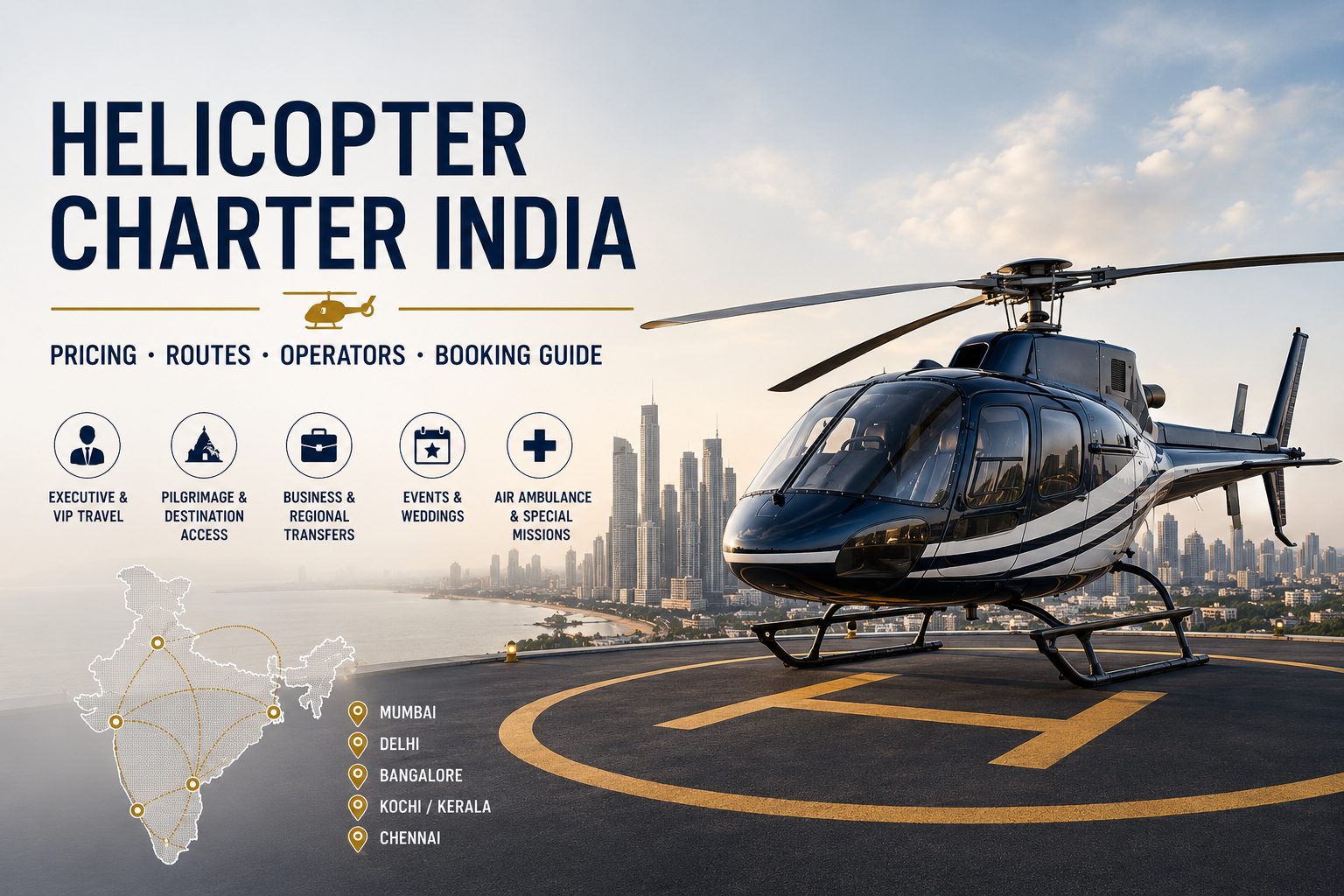
Helicopter charter in India is not a niche side note to private aviation. It is a real market with meaningful scale, distinct use cases, and a very different logic from private jet travel. The helicopter side of the market is not marginal. It is a major part of India’s private and non-scheduled aviation ecosystem.
But India’s helicopter market should not be described as one seamless luxury network. It is fragmented. Some demand comes from VIP and executive movement. Some comes from pilgrimage and destination access. Some comes from premium short-haul regional mobility. Some comes from weddings, events, and family travel. Some comes from air ambulance, organ transport, and other special missions. That mix is exactly what makes the market interesting, and exactly why buyers need a serious guide instead of a generic luxury pitch.
This is also a market under pressure. In 2026, charter and helicopter pricing in India has been hit by sharp fuel cost increases, and the non-scheduled sector is under tighter scrutiny after recent safety concerns. That means helicopter charter in India is not just about who has an aircraft. It is about who can operate the mission credibly, how the route is structured, what airport or landing limitations apply, and whether the quote reflects real operating conditions rather than aspirational sales language.
Quick Answer
Helicopter charter in India works best for short, high-value, access-driven travel. That includes executive transfers, VIP movement, pilgrimage and destination access, event logistics, premium regional trips, and selected emergency or special missions. It usually makes more sense than a private jet when the route is short, the group is small, and the real problem is ground travel, regional access, or timing rather than long-range air travel. Pricing varies widely based on helicopter type, route length, positioning, waiting time, landing arrangements, handling, and taxes. In 2026, fuel cost pressure has pushed many helicopter and charter prices materially higher, so buyers should expect quote volatility and should compare missions carefully rather than relying on old headline pricing assumptions.
Why Helicopter Charter in India Is Different From Private Jet Travel
A helicopter is not a small private jet. That sounds obvious, but a surprising number of weak charter pages blur the distinction. Jets are usually best for longer airport-to-airport premium travel, executive group movement, and intercity or interstate flights where cabin comfort, speed, and range matter most. Helicopters solve a different problem. They are strongest when the mission is short, access-driven, time-sensitive, or built around a route where a car is too slow and a jet is excessive.
That distinction is even sharper in India than in many other markets. India’s helicopter demand is shaped by urban congestion, uneven regional access, pilgrimage routes, destination transfers, VIP schedules, and business movement where a difficult last leg can ruin the value of the day. A helicopter may not beat a jet on speed over longer ranges, but it can absolutely beat both a jet and a car when the real issue is how to move cleanly over a short distance or into a less convenient final destination.
| Mode | Best For | Main Strength | Main Weakness |
|---|---|---|---|
| Private Jet | Longer airport-to-airport premium travel | Range, cabin comfort, group business travel | Less useful for short access-driven missions |
| Helicopter | Short-haul premium mobility and access | Regional transfers, VIP movement, difficult last legs | Higher cost sensitivity on short sectors, more route-specific constraints |
| Car | Simple ground movement | Lower cost and broad availability | Weak when roads, time pressure, or access destroy schedule quality |
What “Helicopter Charter India” Actually Means
The phrase covers several different products, and serious buyers should understand them before looking at quotes.
Point-to-point helicopter transfer
This is the cleanest version of the product. The helicopter moves the passenger from one operating point to another as efficiently as the mission allows. This is common in executive movement, premium destination transfers, and short regional access use cases.
Waiting charter
Some missions require the helicopter to remain available while the passenger attends a meeting, a site visit, a religious stop, a wedding, or a private event. That is a different commercial structure from a simple one-way transfer because the aircraft and crew are being held for the schedule.
Dedicated-use helicopter
Some buyers reserve the helicopter for a broader block of time rather than a single movement. This works for VIP days, custom private itineraries, multi-stop event movement, or special projects.
Broker vs operator
Some sellers directly operate helicopters. Others arrange flights through operators. Both models can work, but the buyer should know who is actually responsible for the aircraft, crew, and execution of the mission.
Private charter vs tourism ride
This distinction matters in India because helicopter tourism and short ride products exist alongside private charter. A private charter is a mission-based aviation service. A joyride or tourism ride is a leisure product. The two should not be confused.
When a Helicopter Makes More Sense Than a Jet or Car
A helicopter makes the most sense when it solves the exact part of the journey that is otherwise expensive in time, awkward in logistics, or weak in access. In India, that usually means short premium regional travel, VIP movement, destination access, site visits, and event-linked mobility. The helicopter is not usually there to compete with a jet over long range. It is there to compress time, cut out a bad road segment, or make a short mission workable.
A helicopter usually makes more sense than a car when the road leg is long, congested, unpredictable, or simply too expensive in terms of time. It makes more sense than a jet when the route is short, the group is small, and the mission is more about access than airport-to-airport travel.
| Best Fit | Weak Fit |
|---|---|
| Short premium transfer | Long-distance travel better suited to fixed-wing aircraft |
| VIP or executive movement | Large groups with heavy baggage |
| Pilgrimage or destination access | Trips where a normal car journey is already efficient |
| Event and wedding logistics | Bookings driven mainly by image, not mission logic |
| Urgent site visit or special mission | Routes with vague landing assumptions or unclear operating setup |
India’s Strongest Helicopter Markets
India does not have one uniform helicopter market. It has several market types.
Mumbai
Mumbai is one of the strongest helicopter demand centers in the country because it combines VIP movement, business travel, short premium regional use, and high-value time-saving demand. It is also one of the clearest examples of how route complexity and fuel costs can reshape helicopter economics quickly.
Delhi
Delhi matters because national-capital logic, government movement, VIP travel, and broader business aviation relevance all give it a central place in India’s helicopter ecosystem. It may not always look as consumer-facing as Mumbai, but no India-level helicopter article feels complete without it.
Bangalore
Bangalore works well as a business-led helicopter city. Executive movement, site visits, premium short-haul mobility, and time-sensitive regional access all fit naturally with the city’s economy and travel patterns. It is one of the strongest South India examples of helicopter utility for serious buyers.
Kochi and Kerala
This is one of the strongest leisure-and-access helicopter markets in India. Kerala’s heli-tourism ecosystem gives the region a very clear use-case mix: VVIP transport, corporate charters, air ambulance, organ transport, pilgrimage, tourism, and helipad management. That is a useful real-world example of how varied and functional the helicopter market can be in India outside the major metros.
Chennai
Chennai is more of a practical utility market than a loud luxury rotor market. Business movement, VIP travel, and selective event-related use give it a place in the national picture, though it is usually stronger as a disciplined premium mobility market than as a spectacle-driven one.
Secondary and selective markets
India also supports thinner helicopter demand in secondary and regional markets, including places where helicopter use is tied to pilgrimage, special private movement, state-level VIP travel, or selective business access. These markets should not be oversold as broad luxury hubs, but they are part of the real national ecosystem.
| Market | Best Use Case | Market Strength | Main Caution |
|---|---|---|---|
| Mumbai | VIP, executive, premium short-haul movement | Very strong demand | Route and cost volatility |
| Delhi | National VIP and business logic | Structurally important | Less naturally leisure-led |
| Bangalore | Executive and site-visit utility | Strong business case | Mission must be access-driven |
| Kochi / Kerala | Gateway, resort, tourism, VVIP, medical | One of India’s strongest mixed-use ecosystems | Not every premium trip needs a helicopter |
| Chennai | Practical premium mobility | Solid utility market | Less identity-defining than Mumbai or Kerala |
Common Use Cases for Helicopter Charter in India
The Indian helicopter market is broader than many people think. It is not limited to wealthy passengers wanting dramatic arrivals.
- Executive and VIP movement: short, controlled, time-sensitive travel where privacy and direct movement matter.
- Regional premium transfers: a helicopter can replace a poor road leg or a clumsy travel segment.
- Pilgrimage and destination access: this is a real part of the ecosystem, not a side note.
- Wedding and event logistics: helicopters remain part of premium ceremonial and event movement in India.
- Air ambulance and organ transport: these are part of the real helicopter ecosystem.
- Special missions and aerial work: the broader non-scheduled fleet supports more than just premium passenger transport.
What Affects Helicopter Charter Pricing in India
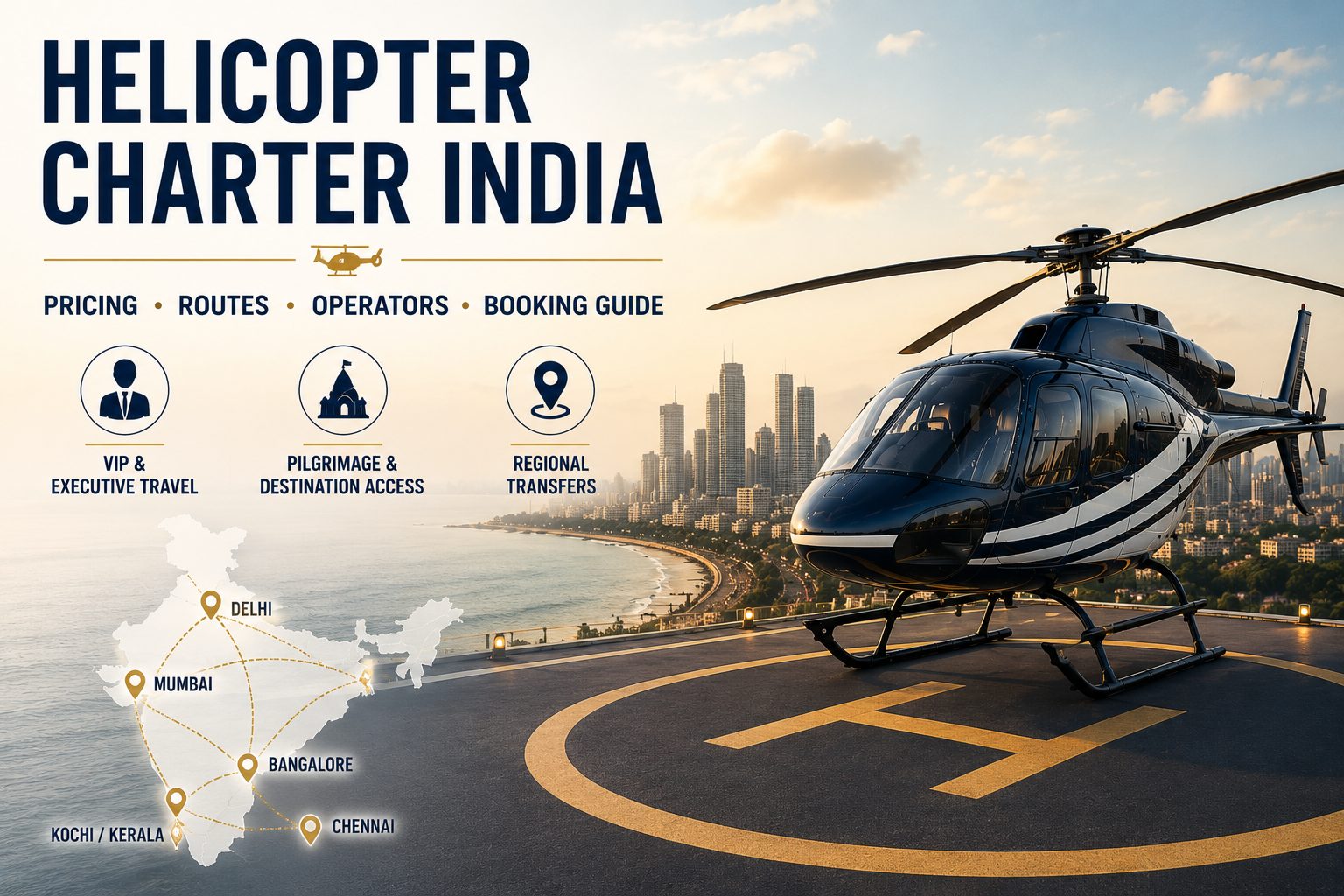
Helicopter pricing in India is highly mission-dependent. The most useful way to explain it is not with one neat number, but with the variables that shape the quote.
Helicopter type
Single-engine and twin-engine helicopters sit in very different commercial positions. A mission built around one will not price the same way as a mission built around the other.
Route and airtime
Longer flights usually mean higher cost, but airtime alone does not tell the full story. Route complexity and mission structure matter too.
Positioning
If the helicopter is not already where it needs to be, repositioning can materially change the quote. This is one of the most important and most misunderstood price drivers.
Waiting structure
A waiting charter where the helicopter remains available during a meeting, event, or stop is not the same product as a simple direct transfer.
Landing arrangements
Helicopters are flexible, but they still need workable landing logic. Site suitability, permissions, and practical setup influence both cost and feasibility.
Handling and taxes
The visible aircraft cost is not always the full number. Buyers should understand what is included, what is excluded, and how taxes affect the total.
On pricing context, market-facing 2026 guidance gives a broad working helicopter charter range in India of roughly ₹80,000 to ₹3,50,000 per hour depending on helicopter type and travel plan. That should be treated as a directional range, not a universal tariff. Real-world reporting from 2026 shows why. Fuel-driven cost pressure has pushed many helicopter and charter prices materially higher, so actual quotes can move sharply depending on route, aircraft, and operating conditions.
| Pricing Factor | Why It Matters |
|---|---|
| Helicopter Type | Different aircraft classes carry different operating economics |
| Route Structure | Distance and mission design both affect the quote |
| Positioning | The aircraft may need to be moved before the passenger even boards |
| Waiting Time | Holding the helicopter changes the commercial structure |
| Landing Setup | Permissions and practicality affect both cost and feasibility |
| Fuel, Handling, Taxes | These can move sharply and materially change the final number |
Single-Engine vs Twin-Engine Helicopters
This choice shapes both mission fit and pricing, so buyers should understand it clearly.
A single-engine helicopter often fits practical premium transfers and shorter regional movements where the mission is straightforward and cost discipline matters. A twin-engine helicopter often sits higher in the premium stack and may suit broader VIP expectations, more demanding mission profiles, or buyers who want a stronger high-end positioning. Neither category is automatically better. The mission should decide.
| Factor | Single-Engine | Twin-Engine |
|---|---|---|
| Typical Cost Position | Usually lower | Usually higher |
| Best Fit | Practical premium transfers, shorter missions | Higher-end VIP, broader premium, more demanding mission use |
| Main Buyer Logic | Utility and efficiency | Capability and premium positioning |
| Common Mistake | Rejecting it too quickly for image reasons | Paying extra mainly for prestige |
Is It Easy to Book a Helicopter in India at Short Notice?
Sometimes yes, but short notice in India depends heavily on where the mission is happening and how clearly it is defined.
A same-day or short-notice helicopter booking can work well when the route is known, the aircraft is positioned sensibly, and the landing logic is already practical. It becomes harder when the mission is vague, the route is unusual, the operating point is uncertain, or the buyer assumes unrestricted access everywhere.
This is one reason India should not be sold as an instant air-taxi fantasy. The market is real, but it is fragmented. Availability alone does not equal a cleanly executable mission.
How to Compare Helicopter Charter Quotes in India
A serious buyer should compare helicopter offers with the same discipline used for any premium operational purchase.
- What helicopter type is actually being offered?
- Who is the real operator?
- Is this the final aircraft or only a provisional option?
- Is repositioning included in the price?
- Is waiting charged, and how?
- Are landing arrangements confirmed or only assumed?
- What taxes and extras are excluded from the headline quote?
- How realistic is the timing being promised?
The strongest quote is not the one with the most dramatic language. It is the one that explains the mission clearly enough that the buyer understands the real structure of the trip.
Safety, Regulation and Why Operator Quality Matters More Now
Operator quality matters in every aviation market. In India, it matters even more now because the non-scheduled sector is under heavier public and regulatory scrutiny. Tighter rules, stronger audits, and greater attention to oversight mean buyers should care about more than the aircraft and the visual presentation of the charter brand. They should care about how the mission is actually being run.
This does not mean every customer needs to become an aviation regulator. It does mean serious buyers should ask better questions. Who operates the mission? How realistic is the route? Is the aircraft clearly identified? Is the mission being sold honestly? In a market under closer scrutiny, transparency becomes part of the product.
Common Booking Mistakes
- Comparing only on hourly rate. That ignores positioning, waiting, and landing structure.
- Treating helicopters like small jets. The mission logic is different.
- Assuming every city or destination works the same way. India’s helicopter market is highly uneven.
- Ignoring landing practicality. A flexible aircraft still needs a workable mission.
- Confusing private charter with joyride or tourism products. These are not the same.
- Booking for image rather than mission fit. Helicopters are strongest when they solve a real movement problem.
Is Helicopter Charter in India Worth It?
For the right mission, yes.
Helicopter charter in India can be worth the cost when the trip is short, time-sensitive, access-driven, or valuable enough that saving time changes the quality of the day. It can also be worth it for VIP movement, premium destination access, curated regional journeys, event logistics, and special missions where alternative transport is clumsy or slow.
It is less likely to feel worth it when the buyer is comparing only against a car or airline fare and ignoring the actual value of the mission. The strongest justification is simple: the helicopter solves a specific transport problem better than the alternatives.
FAQ
How much does a helicopter charter in India usually cost?
There is no single fixed rate. A broad working range in 2026 has been described at roughly ₹80,000 to ₹3,50,000 per hour, but actual quotes vary widely depending on helicopter type, route, positioning, waiting, landing arrangements, fuel, and taxes.
What affects helicopter pricing the most?
The biggest factors are usually helicopter type, mission structure, positioning, waiting time, landing setup, handling, taxes, and fuel conditions.
Is helicopter charter in India mainly for luxury travelers?
No. Luxury and VIP demand are part of the market, but India’s helicopter ecosystem also includes executive movement, premium regional transfers, pilgrimage access, air ambulance, organ transport, and special missions.
Can I book a helicopter in India on the same day?
Sometimes yes, especially in stronger markets and clearer mission profiles. But same-day feasibility depends on more than aircraft availability. Positioning, route, timing, and landing practicality all matter.
What is the difference between single-engine and twin-engine helicopters?
Single-engine helicopters are often better for practical short premium missions and may sit lower in the cost stack. Twin-engine helicopters often fit broader VIP or higher-end use cases and usually cost more. The right choice depends on the mission, not just the image of the aircraft.
Can a helicopter be better than a private jet for some trips?
Yes. On short, access-driven, or highly time-sensitive missions, a helicopter can be the better tool because it solves a different travel problem than a jet.
Which regions are strongest for helicopter charter in India?
Mumbai, Delhi, Bangalore, and Kochi/Kerala are among the strongest reference markets, though each supports different types of helicopter demand.
What should I check before confirming a helicopter booking?
Check the helicopter type, operator identity, what is included in the quote, whether waiting and positioning are involved, and whether the landing and timing assumptions are realistic for the route you actually need.
Final Thought
If you are considering helicopter charter in India, the smartest way to evaluate it is not as a luxury fantasy but as a mobility decision. What part of the journey does it improve. How much time does it protect. Whether the route truly suits a helicopter. Whether the quote is transparent. Whether the operator setup feels credible. Whether the premium is buying real usefulness rather than just visual impact.
That is the right lens for India. This is a real, sizable, and highly varied helicopter market. It is not equally easy everywhere, and it is not equally sensible for every trip. But when the mission fits, the value of helicopter travel in India can be very real.