
Private jet charter in India is no longer a topic limited to a handful of ultra-wealthy travelers chasing prestige. The market is broader than that. Today, private flights in India are used for executive mobility, founder and investor travel, family office movement, premium leisure, private group trips, urgent business schedules, and journeys where airline timing simply does not fit the value of the day. That is the real starting point. A private aircraft in India is often a mobility solution first and a luxury product second.
This matters because India is not one simple charter market. It is a market of contrasts. Some cities are strong because of demand. Some are strong because of airport infrastructure. Some work well for executive travel. Others work better as premium gateways or family arrivals. A private flight that makes perfect sense in Mumbai may not be structured the same way in Kochi or Vijayawada. Airport access, operator quality, positioning, handling, timing, and the true shape of the journey all matter more than many first-time buyers expect.
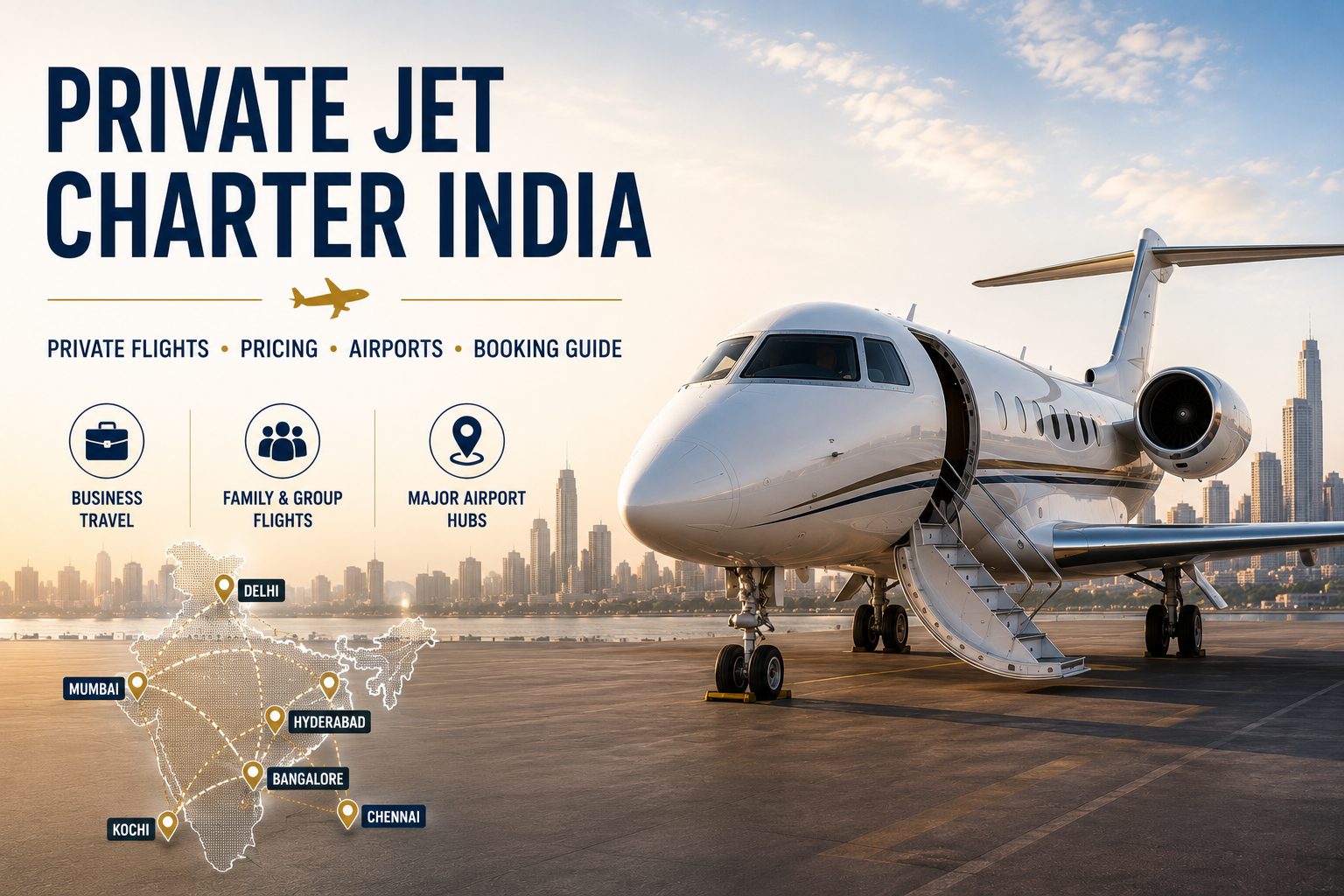
That is why a serious article on private jet charter in India should not read like a glossy brochure. Buyers do not just need a list of aircraft. They need a way to understand how private flights actually work in India, what affects the quote, which cities matter most, when a jet is the right answer, and how to compare offers without getting distracted by branding alone. That is the goal of this guide.
Quick Answer
Private jet charter in India works best for business, private, and high-value travel where time, privacy, flexibility, or group coordination matter more than standard airline fares. The strongest markets tend to be major business and gateway cities, but demand also exists in selective regional markets when the mission is clear. Final pricing usually depends on aircraft type, route length, positioning, airport handling, waiting time, parking, crew structure, and taxes. The most important thing to understand is that private flights in India are not one uniform product. Airport reality, operator quality, and mission fit matter almost as much as the aircraft itself.
Why India Is Becoming a Bigger Market for Private Jet Charter
India supports private aviation because it produces exactly the kind of travel conditions that make charter useful. The country has large distances between major commercial centers, major differences in airport experience from city to city, fast-moving executive schedules, premium family travel, and a growing class of travelers who are willing to pay for control when standard travel structures create too much friction.
Some private charter demand is obviously luxury-led. That part exists. But a larger and more durable layer of demand comes from travelers who are not buying glamour for its own sake. They are buying efficiency. A founder wants to protect a meeting day. A family office wants privacy and schedule control. A senior team wants to move together. A family wants a smoother long-distance arrival. A business owner wants to avoid losing hours to indirect flights, rigid schedules, and airport dead time. In those cases, a private flight becomes easier to justify.
There is also a strong geographic logic. India is large enough, varied enough, and operationally uneven enough that premium mobility has real value. A traveler is often not comparing a private aircraft to a perfect alternative. The traveler is comparing it to a combination of traffic, connection risk, weak timings, airport inefficiency, and lost hours around the actual flight. Once that comparison becomes clear, the charter market makes more sense.
What “Private Jet Charter India” Actually Means
The phrase sounds simple, but it covers several different products and buying structures. A stronger buyer understands that before requesting the first quote.
Broker vs operator
Some companies directly operate aircraft. Others arrange the mission through licensed operators. Both models can work well. The buyer just needs to understand who is actually responsible for the aircraft and the execution of the mission.
One-way vs return charter
A one-way private flight is not always the most economical-looking mission once positioning and return logic are considered. A return charter may appear more expensive upfront while making better operational sense overall.
Private flights vs scheduled travel alternatives
Buyers often compare a private jet only to business class. That is too narrow. A private flight is also buying control over timing, group movement, privacy, baggage flexibility, and how much of the day is lost to the travel process around the flight.
Domestic vs international private flight planning
A domestic private charter in India is one type of mission. An international private departure or arrival is another. The buyer should not assume that the same structure, quote logic, and timing expectations apply equally to both.
Jet vs turboprop
Not every private flight in India needs a jet. Some shorter or more practical regional trips may be better served by a turboprop. The best aircraft is the one that fits the mission, not the one that sounds most premium in a headline.
How Private Flights Work in India
Private flights in India are built through mission planning, not just aircraft selection. That distinction is one of the most important things for buyers to understand.
A first-time customer may imagine the process like this: choose a city, choose a jet, pay a quote, fly. Sometimes the trip can feel that simple from the passenger side, especially when it is well arranged. Behind the scenes, though, the mission still depends on several moving parts. Aircraft availability matters. Positioning matters. Airport handling matters. Timing matters. Crew structure matters. The quote reflects all of that, not just the time spent in the air.
This is especially important in India because the country is not one seamless premium aviation environment. Some airports are far more practical for private aviation than others. Some routes are straightforward. Others are commercially workable but less elegant. Some markets support premium executive travel naturally. Others are more selective. That does not make the market weak. It just means that serious private flying in India rewards preparation more than impulse.
Why Airport Access Matters as Much as the Aircraft
A lot of weak charter content talks almost only about the aircraft. Serious buyers learn very quickly that the airport side of the trip is just as important.
The airport shapes how the mission begins, how cleanly the passenger is handled, how much waiting and coordination are involved, whether the trip feels smooth or awkward, and how realistic the schedule actually is. A strong aircraft paired with weak airport-side assumptions is not a strong private flight. It is just an expensive promise.
This matters more in India because airport infrastructure is uneven. Some cities feel far more natural for premium aviation. Others are workable, but not equally polished. Buyers should expect significant differences between major business hubs, premium gateways, and secondary airports. That difference does not need to be hidden. In fact, a good charter guide should explain it clearly because it helps travelers understand why some routes and cities feel more straightforward than others.
India’s Strongest Private Aviation Cities
India does not have one dominant charter pattern. It has several city types that each support private aviation in different ways.
Mumbai
Mumbai is one of the strongest charter cities in India because it combines business demand, premium travel, VIP movement, private wealth, and urgent same-day commercial logic. It is one of the country’s most visible private aviation markets, but it is also one of the easiest places to underestimate from an operational standpoint. Strong demand does not always mean effortless execution.
Delhi
Delhi matters because it combines capital-city relevance, business travel, diplomatic relevance, premium mobility, and national visibility. Any India-level private aviation article feels incomplete without it because Delhi anchors part of the country’s business-aviation identity.
Bangalore
Bangalore works especially well as an executive and founder-driven charter city. It is one of the strongest business-led private aviation markets in South India, not because it is glamorous, but because it generates a lot of time-sensitive, high-value travel.
Hyderabad
Hyderabad has a serious role in business aviation through its commercial profile and aviation ecosystem. It often sits in the top tier of relevant Indian charter cities even if it is discussed less dramatically than Mumbai.
Chennai
Chennai works as a practical corporate and industrial charter market. It is less glamour-heavy than Mumbai and less startup-branded than Bangalore, but it remains a very sound city for serious executive mobility.
Kochi
Kochi is one of the most interesting markets because it combines business relevance, premium leisure relevance, and gateway logic. It is one of the best examples in India of a city where airport-side strength and premium travel flow work together to create a stronger private aviation story.
Secondary and regional markets
India also supports a layer of selective regional charter demand. Cities like Vijayawada and other secondary markets can work well when the mission is specific, time-sensitive, or access-driven. These markets should not be oversold as large luxury hubs, but they can still support meaningful private aviation use cases.
What Affects Private Jet Pricing in India
Private jet pricing in India is not a neat one-line number. It is the result of the entire mission structure.
Aircraft type
A light jet, midsize jet, large cabin aircraft, and turboprop all sit in different commercial positions. The aircraft should be chosen based on mission fit, not on image alone.
Route and flight time
Longer sectors generally cost more, but route complexity matters too. A route that looks simple on a map may still involve broader commercial structure depending on timing and mission design.
Positioning
If the aircraft is not already in the right place, it may need to reposition. This is one of the biggest sources of confusion for first-time buyers because it can materially change the quote.
Airport handling and support
Handling, passenger support, and airport coordination all affect the total price and the quality of the trip. The ground side is part of what the traveler is paying for.
Waiting and parking
A quick-turn mission, a wait-and-return trip, and an overnight aircraft commitment are not the same commercial product. The quote should reflect the true structure of the trip.
Crew and mission timing
Tailored timing, special departures, or broader operational demands may affect the economics of the mission beyond simple airtime.
Taxes and extras
The first quote number may not capture everything. Buyers should always understand what is included and what is not before comparing offers.
| Pricing Factor | Why It Matters |
|---|---|
| Aircraft Type | Different aircraft categories bring different operating costs and mission fit |
| Route Structure | Distance and trip design both shape the final quote |
| Positioning | The aircraft may need to arrive from another base |
| Handling and Support | Airport-side execution adds cost and affects trip quality |
| Waiting or Overnight Use | Holding the aircraft changes the economics of the mission |
| Taxes and Extras | The true total may be higher than the first visible number |
Choosing the Right Aircraft for a Private Flight in India
The best aircraft is not always the most expensive one. It is the one that fits the mission closely enough that the traveler gets real value without overspending.
Light jets
Light jets can work well for shorter executive sectors, smaller groups, and sharper business travel where speed and privacy matter.
Midsize jets
Midsize jets often provide the strongest balance between comfort and practicality. They can serve both executive and premium private travel very effectively.
Large cabin aircraft
These aircraft can be excellent for senior groups, higher-end family travel, or longer-range missions where comfort and space matter more. They can also be overkill if the mission is quite simple.
Turboprops
Turboprops should not be underestimated. On some shorter and more practical Indian routes, they may be the smarter choice. Mission value matters more than prestige vocabulary.
| Aircraft Type | Best Fit | Main Strength | Main Caution |
|---|---|---|---|
| Light Jet | Shorter executive sectors, smaller groups | Efficient premium movement | Less cabin and baggage flexibility |
| Midsize Jet | Balanced executive and private travel | Comfort plus strong versatility | Can cost more than needed for simple missions |
| Large Cabin Aircraft | Higher-end groups, longer trips, family travel | Space and premium comfort | Easy to overspecify |
| Turboprop | Practical shorter routes and regional travel | Strong mission economics | Less appealing to image-led buyers |
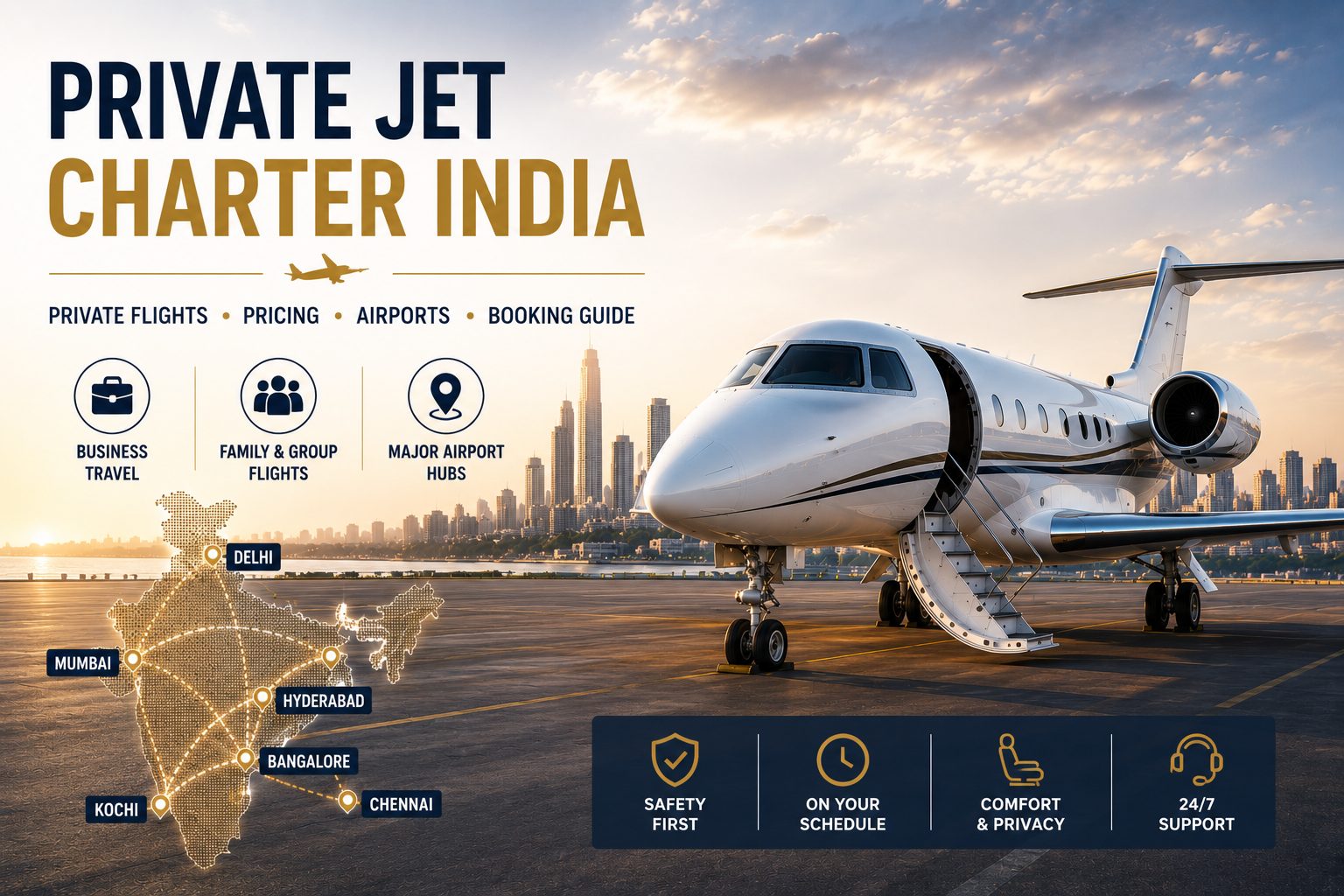
Business Travel vs Leisure Travel in India’s Charter Market
India’s private aviation market supports both business and leisure, but the value logic differs.
Business travelers usually care most about:
- time control;
- same-day efficiency;
- group movement;
- privacy;
- reducing travel drag around a valuable schedule.
For these travelers, the private aircraft is usually a time-management tool first and a premium product second.
Leisure travelers usually care most about:
- comfort;
- family or group coordination;
- baggage flexibility;
- smoother arrivals and departures;
- a calmer and more private travel flow.
For these travelers, the emotional side of the purchase matters more, but the strongest decisions still come from mission fit rather than branding alone.
How to Compare Private Jet Quotes in India
A disciplined buyer compares private jet quotes the same way a disciplined executive compares any premium operational purchase. Carefully and without getting distracted by surface polish.
At a minimum, compare:
- aircraft type and suitability for the mission;
- whether the seller is the operator or an arranger;
- where the aircraft is positioned;
- what is included in the quote;
- whether waiting, parking, or overnight use is assumed;
- how realistic the schedule is;
- how changes or cancellations are handled;
- whether the quote feels transparent or theatrically vague.
The best quote is rarely the loudest one. It is the one that explains the mission clearly enough that the buyer understands why the number looks the way it does.
Safety, Regulation and Why Operator Transparency Matters More Now
In a serious private aviation market, operator quality matters. That is especially true in a country as varied and operationally complex as India. Buyers should care about more than the aircraft and the visual presentation of the charter brand. They should care about how the mission is being run.
That does not mean turning every booking into an aviation audit. It simply means asking better questions. Who is the actual operator? What aircraft is really being proposed? Is the quote realistic? Is the mission being presented clearly? Is the provider selling a workable flight or only a polished story? The most experienced buyers usually care about those questions more than first-timers do, and there is a reason for that.
Common Mistakes People Make When Booking a Private Jet in India
Most booking mistakes come from treating India as one uniform private aviation market. It is not.
- Comparing only on price.
- Assuming every airport works equally well for private aviation.
- Choosing aircraft for image rather than mission fit.
- Ignoring positioning and handling.
- Not checking who is actually operating the flight.
- Expecting instant luxury simplicity everywhere.
- Confusing a strong city market with a strong national uniform experience.
The strongest buyers are usually the ones who understand that a private flight is not just an aircraft booking. It is a complete mission.
Is Private Jet Charter in India Worth It?
For the right traveler, yes.
Private jet charter in India can be worth the cost when the mission is business-critical, family- or group-led, time-sensitive, privacy-sensitive, or built around a schedule that commercial flying handles badly. It can also be worth it when airport and journey control improve the trip in a way that standard travel cannot match.
It becomes less persuasive when the buyer compares only against a commercial ticket and ignores the total mission value. A private jet is not just a better seat. It is a different way of organizing the trip. That is where the real value usually sits.
FAQ
How much does a private jet charter in India usually cost?
There is no single fixed price. The total depends on aircraft type, route structure, positioning, airport handling, waiting or overnight use, taxes, and the overall complexity of the mission.
Which cities are strongest for private jet charter in India?
Mumbai, Delhi, Bangalore, Hyderabad, Chennai, and Kochi are among the strongest and most relevant markets, though each works differently.
Can I book a private jet in India on short notice?
Sometimes, yes. But short-notice success depends on aircraft availability, positioning, mission clarity, airport practicality, and realistic timing.
What affects pricing the most?
The biggest factors are aircraft category, route length, positioning, handling, waiting structure, and taxes or other mission-related extras.
Is a broker the same as an operator?
No. An operator directly runs the aircraft. A broker or arranger may source and coordinate the mission through an operator. Buyers should know who is responsible for execution.
When does a turboprop make more sense than a jet?
On some shorter and more practical routes, a turboprop may offer better mission fit and stronger economics than a jet.
Are private jet charters in India only for ultra-wealthy travelers?
No. They are still premium products, but many are justified by business value, family logistics, group coordination, time savings, or schedule control rather than only by status.
What should I check before confirming a charter?
Check the aircraft type, operator identity, positioning logic, what is included in the quote, how waiting is handled, and whether the mission has been structured realistically for the trip you actually need.
Final Thought
If you are considering a private jet charter in India, the smartest way to evaluate it is not through fantasy or pure luxury language. Evaluate it as a mission. What problem does the aircraft solve. How much time does it protect. Whether the airport side works well. Whether the quote is transparent. Whether the provider is selling a real travel solution or just a polished promise.
That is the right lens for India. This is a growing, uneven, highly useful private aviation market. It is not one seamless premium zone, and that is exactly why serious buyers benefit from understanding how it really works. When the mission fits, the value of a private flight in India can be very real.